



Liam, a 28-year-old civil engineer, sat in his home office at 11:47 PM on a Tuesday. He had just watched another video promising a six-figure income from Shopify dropshipping. The math seemed simple: find a cool product on AliExpress, mark it up 3x, run some Facebook ads, and watch the money roll in. He had already spent $400 on a “premium” dropshipping course and another $29 on his first month of Shopify. He was all in.
Six weeks later, Liam was staring at his Shopify dashboard. He had made four sales. Total revenue: $127. His Facebook ad spend? $1,840. He had lost over $1,700, and he still hadn’t factored in the cost of the apps he installed to make his store look halfway decent. This is the reality of Shopify dropshipping in 2026 that the gurus don’t talk about. It’s not a business model; for most beginners, it’s a high-speed cash incinerator.
But here’s the thing: Liam’s story doesn’t have to end in failure. The desire to build a location-independent income stream is valid. The mistake isn’t the ambition; it’s the platform. While Shopify forces you to become a master of paid traffic overnight, there’s a parallel e-commerce universe where the traffic is already there, waiting for you. That universe is Etsy, and the smarter, more sustainable model is Print on Demand (POD).
Why Shopify Dropshipping Became a Trap for Beginners
Shopify is a brilliant piece of software. It’s a blank canvas that lets you build anything. But that’s also its fatal flaw for newcomers. A blank canvas doesn’t come with an audience. When you open a Shopify store, you are invisible. You have zero traffic, zero trust, and zero sales. To fix this, you have to buy attention, and in 2026, that attention is more expensive than ever.
📈 The average cost-per-click (CPC) for Facebook ads in the US has increased by 17% year-over-year, making it nearly impossible to test products profitably on a small budget.
The High Cost of “Free” Traffic
Let’s break down the real math of starting a Shopify dropshipping store. You’ll need a Shopify plan ($39/month is the minimum for a functional store), a domain name, and a few essential apps for upsells, reviews, and email capture. Before you even run a single ad, you’re looking at a fixed cost of around $70-$100 per month.
But the real killer is the ad spend. To test a single product, you need to run a campaign. A proper test requires at least $50-$100 per day over 3-5 days to gather enough data. If that product fails, you start over with a new one. It’s common for beginners to burn through $500-$1,000 in ad spend before finding a product that even breaks even. This is the “learning tax,” and it’s a luxury most people can’t afford. For a deeper dive into why this model is so punishing, check out our breakdown of Shopify Dropshipping in 2026: The Brutal Truth About Costs vs. Reward.

The “Overnight Millionaire” Myth
The dropshipping videos on YouTube create a dangerous illusion. They show you the revenue, not the profit. A store might do $10,000 in sales in a month, but after a 30% product cost, 40% ad spend, and 10% in app and transaction fees, the owner might be pocketing $2,000 while working 60-hour weeks managing customer complaints about 3-week shipping times from AliExpress.
This myth is perpetuated by course sellers who make more money from selling the dream than from actually running dropshipping stores. The market has shifted. Customers are savvier. They can reverse-image search a product and find it on Amazon for cheaper. They demand fast shipping, which dropshipping from overseas suppliers simply cannot provide. The result is a high rate of chargebacks, account bans from payment processors, and a reputation that’s impossible to rebuild.
The Etsy Print on Demand Alternative: Traffic You Don’t Pay For
Now, imagine a different starting point. Instead of building a store in the middle of an empty desert and screaming into the void, you set up a shop inside a bustling, world-famous marketplace. That’s Etsy. Etsy isn’t just a website; it’s a destination. Over 90 million active buyers come to Etsy specifically looking for unique, handmade, and customized products. They are not scrolling through a social feed; they are typing in search queries with their credit card ready.
This is the fundamental difference between Shopify dropshipping and Etsy Print on Demand. With Shopify, you pay for every single pair of eyeballs. With Etsy, you tap into a massive, organic search engine built for buyers. You don’t need to be a marketing genius; you just need to understand how to help the right buyers find your product. This is what we call the “Built-in Audience Advantage.”
💡 Etsy’s search algorithm favors shops that consistently list new, high-quality products. A steady listing cadence is often more effective than a large ad budget.
What is Print on Demand, Really?
Print on Demand is a fulfillment model where you partner with a supplier to print your custom designs on white-label products (like t-shirts, mugs, and tote bags). You only pay for the product after a customer places an order. This means you hold zero inventory. You don’t buy a hundred mugs and hope they sell. You create a design, list it on a mug, and when a customer buys it, the supplier prints it, packages it, and ships it directly to your customer with your branding.
This model eliminates the two biggest risks of traditional e-commerce: inventory costs and fulfillment headaches. You can test a new design, a new niche, or a new product type with zero financial risk. If it doesn’t sell, you’re out the 20 minutes it took to create the listing, not the $500 you would have spent on stock. This is the core of a resilient, low-risk business model, and it’s the exact opposite of the high-stakes gambling of Shopify dropshipping.
The Financial Comparison: A Side-by-Side Look
Let’s put the numbers side-by-side for a realistic first month. We’ll assume a beginner with a limited budget trying to reach $1,000 in sales.
Shopify Dropshipping Scenario:
Shopify Plan: $39
Essential Apps: $45
Domain: $14
Facebook Ads (to get traffic): $800
Total Fixed Cost to Start: $898
Sales Revenue: $1,000
Product Cost (COGS): $300
Net Profit/Loss: -$198 (You lost money, and this assumes you even know how to run profitable ads).
Etsy Print on Demand Scenario:
Etsy Listing Fees: $2.00 (for 10 listings at $0.20 each)
POD Tool (like Listybox): $0 (Free plan available)
Marketing Cost: $0 (organic Etsy traffic)
Total Fixed Cost to Start: $2.00
Sales Revenue: $1,000
Product Cost (COGS) & Etsy Fees: ~$450
Net Profit: +$550 (You are profitable from day one, without spending a dime on ads).
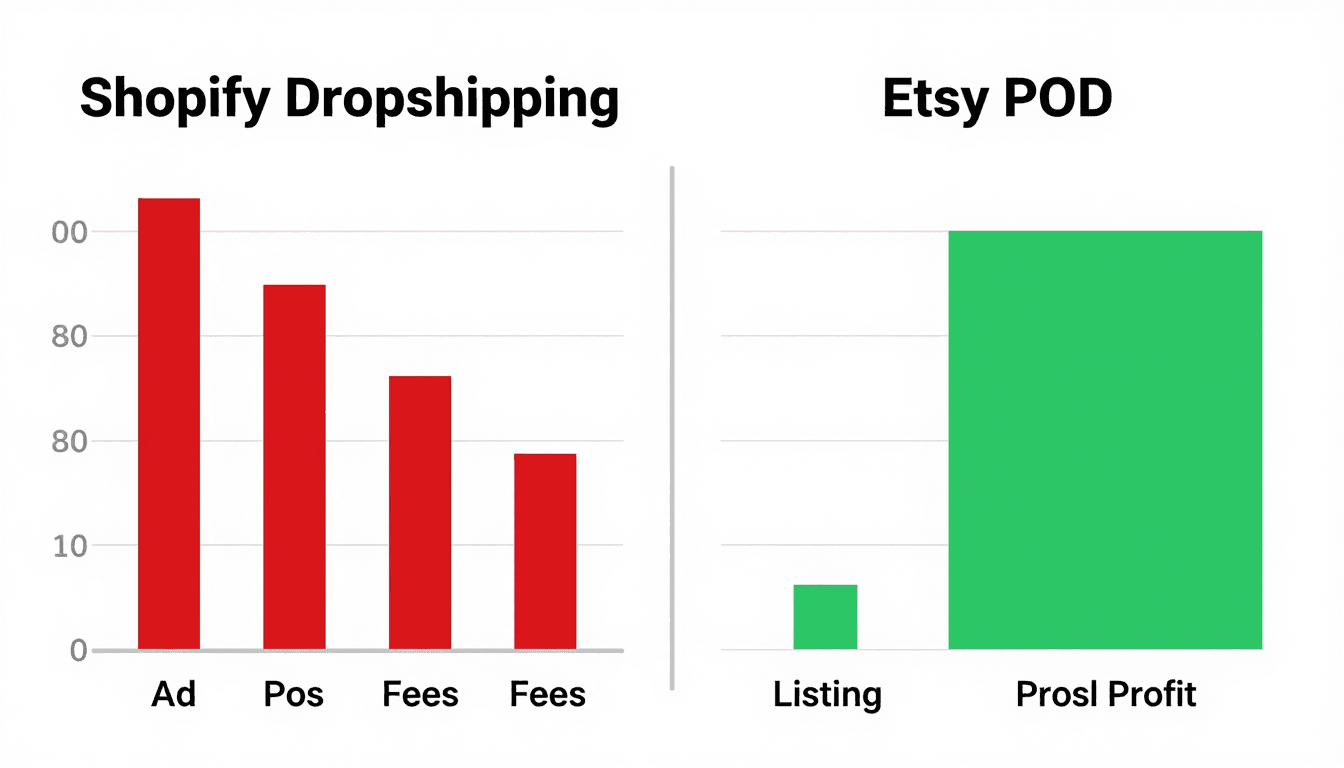
This isn’t a hypothetical. This is the mathematical reality of the two models. Shopify requires you to be a world-class marketer from day one. Etsy allows you to be a creator and a product developer, and it rewards you for it. If you want a complete blueprint for this model, read our guide on How to Sell Products Without Inventory in 2026: The Complete Etsy Print-on-Demand Blueprint.
The Hidden Trap of Shopify: You’re in the Traffic Business, Not the Product Business
The cruelest irony of Shopify dropshipping is that you don’t sign up to be a media buyer, but that’s the job you end up doing. Your daily routine isn’t about improving your product or delighting your customers. It’s about obsessively refreshing your Facebook Ads Manager, tweaking audiences, duplicating ad sets, and praying that iOS privacy updates haven’t destroyed your pixel’s ability to track conversions.
You become a slave to the ad platforms. When Facebook goes down, your business goes down. When ad costs spike during Q4, your profit margins evaporate. You are not building a brand; you are arbitraging attention, and that window is closing faster every year. The businesses that survive are the ones with deep pockets and sophisticated media buying operations, not solo entrepreneurs working from their kitchen table.
The “Winning Product” Hamster Wheel
The dropshipping model is built on finding a “winning product.” This is a product that is currently untapped, has a high perceived value, and can be sold for a large markup. The problem is that the moment a product is “winning,” it’s already dying. Hundreds of other dropshippers are using the same spy tools to find the same product and launch the same generic store. Within weeks, the market is saturated, ad costs for that product skyrocket, and the profit is gone.
You are then forced to start the process all over again. Find a new product, build a new ad creative, launch a new campaign. This is a hamster wheel of burnout. You never build equity. You never build a customer base. You are constantly starting from zero. This is why so many Shopify dropshippers quit after 6 months, exhausted and broke.
How to Build a Real Asset on Etsy with Print on Demand
Etsy Print on Demand flips the script. Instead of chasing temporary products, you build a portfolio of intellectual property: your designs. Each design you create is an asset that can generate passive income for years. When you upload a design to a POD platform and list it on multiple products, you are not just creating a listing; you are planting a seed.
A single, well-optimized listing can rank in Etsy’s search results and generate sales for 2, 3, or even 5 years. You don’t have to constantly spend money on ads to keep it alive. The organic traffic from Etsy sustains it. This is the power of building a brand on a platform that rewards longevity and quality, not just ad spend.
The Power of Design Ownership
When you create a design, you own it. You can put it on a t-shirt, a mug, a tote bag, a hoodie, a phone case, and a wall art print. You can create a cohesive brand around a specific style or niche, like “funny cat mom gifts” or “inspirational engineering quotes.” This is how you build a true brand. Customers start to recognize your style. They come back to your shop to see what’s new. They tell their friends.
This is impossible in the generic dropshipping world where you’re selling the same LED lights and posture correctors as everyone else. With POD, you are the differentiator. Your creativity is the moat that protects your business from competition. You can’t easily copy a unique artistic style, but anyone can copy a dropshipping product in 30 seconds.
⚠️ Don’t fall into the trap of using generic, AI-generated designs that look like everyone else’s. Spend time developing a unique visual style or niche. This is what builds a defensible brand on Etsy.
Scaling Without Multiplying Your Workload
This is where the smartest Etsy sellers separate themselves from the pack. Creating a single design and listing it on one product is a start. But the real magic happens when you use intelligent automation to scale. Imagine you have a “bestseller” design. Instead of manually listing it on 50 different products, which would take a week of tedious work, you can use a tool like the Creation Wizard to do it in minutes.
This is the factory model for creatives. You invest your time in the design, and the software handles the repetitive, soul-crushing work of resizing, placing, and publishing. This is how you go from a side hustle making a few hundred dollars a month to a full-time income without working 100-hour weeks.
The Tools That Make Etsy POD a True Business, Not a Side Hustle
Succeeding on Etsy isn’t just about listing products. It’s about listing them correctly. The difference between a listing that gets 1,000 views a month and one that gets 10 views often comes down to SEO. Etsy’s search algorithm needs to understand what you’re selling. It does this by analyzing your title, tags, and description.
This is where many creative people struggle. They can design a beautiful t-shirt, but they don’t know how to write a title that ranks. They don’t know which keywords buyers are actually typing into the search bar. This is a skill gap, not a creative failure. And it’s a gap that can be closed with the right tools.
Mastering Etsy SEO Without Being an Expert
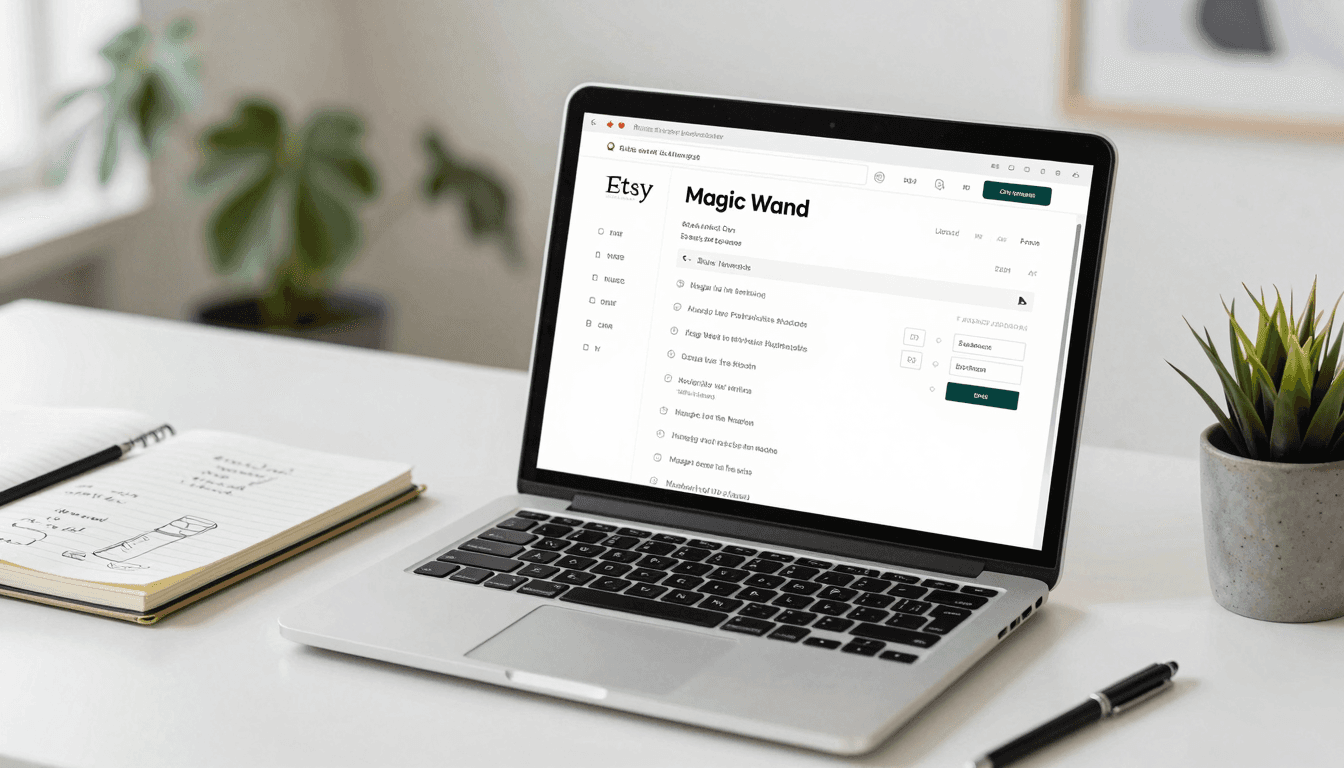
Instead of spending hours on manual keyword research tools, you can use a system that analyzes the top-performing listings in your niche and instantly generates an optimized title, tags, and description for you. This isn’t about generic AI; it’s about a system fine-tuned specifically for Etsy’s unique algorithm.
The Magic Wand SEO tool does exactly this. It takes the guesswork out of SEO. You tell it what your product is, and it builds a listing that is designed to be found. This single step can be the difference between a shop that gets lost in the noise and one that starts generating organic sales within the first week. For a more detailed breakdown of how to optimize your shop, check out our Etsy Listing SEO Optimization: Your Step-by-Step Guide to Visibility and Sales.
The Visual Advantage: Why Mockups Matter More Than You Think
In a dropshipping store, you’re often stuck with the same generic product photos that thousands of other stores are using. On Etsy, your product photos are your first impression. A flat, boring mockup screams “amateur” and gets scrolled past. A stunning, lifestyle image that shows the product in a real-world setting stops the scroll and drives clicks.
But creating these lifestyle photos traditionally requires buying expensive mockup bundles or hiring a photographer. The ListyStyle mockup creator changes this. It allows you to generate hundreds of unique, professional lifestyle images with a single click. You can place your design in a beautifully lit living room, a modern office, or a cozy coffee shop. This visual upgrade can increase your click-through rate by up to 5x, which directly impacts your sales and your ranking in Etsy’s algorithm. The visual edge is a real competitive advantage; learn more about it in our guide on The Visual Edge: How Product Mockups Boost Etsy Sales Conversion.
The Path Forward: From Burnout to a Sustainable Business
Liam, the engineer from our introduction, eventually closed his Shopify store. He didn’t give up on e-commerce, though. He realized he loved the creative process of finding a niche and designing for it, but he hated the marketing grind. He switched to Etsy Print on Demand and started a shop focused on clever, minimalist designs for civil engineers.
He used his first month to create 20 designs. He used the Magic Wand SEO tool to optimize his listings. He used the ListyStyle mockup creator to make his products look premium. He didn’t spend a single dollar on ads. In his third month, his shop made $2,800 in profit. He was finally building something real. He was building an asset, not feeding a money pit.
The choice between Shopify dropshipping and Etsy POD is a choice between two different philosophies. One is a high-stakes, high-stress gamble on paid traffic and fleeting trends. The other is a methodical, creative, and sustainable path to building a real brand and a real income stream. You don’t need to be a marketing expert. You don’t need a massive budget. You just need a platform that works for you, not against you.
Start your free trial - no credit card required and get access to the tools that turn your creativity into a profitable, long-term business.
Put this into practice in your shop.
Every step from design to live listing, on one platform. Start on the free plan.
No credit card required.
Related posts
Shopify Dropshipping in 2026: The Brutal Truth About Costs, Profits, and the Smarter Alternative
Jul 16, 2026

Shopify Dropshipping: The Brutal Truth About Why It Fails (And What to Do Instead)
Jul 14, 2026
Shopify Dropshipping in 2026: The Brutal Truth About Costs, Profits, and the Smarter Alternative
Jul 13, 2026