
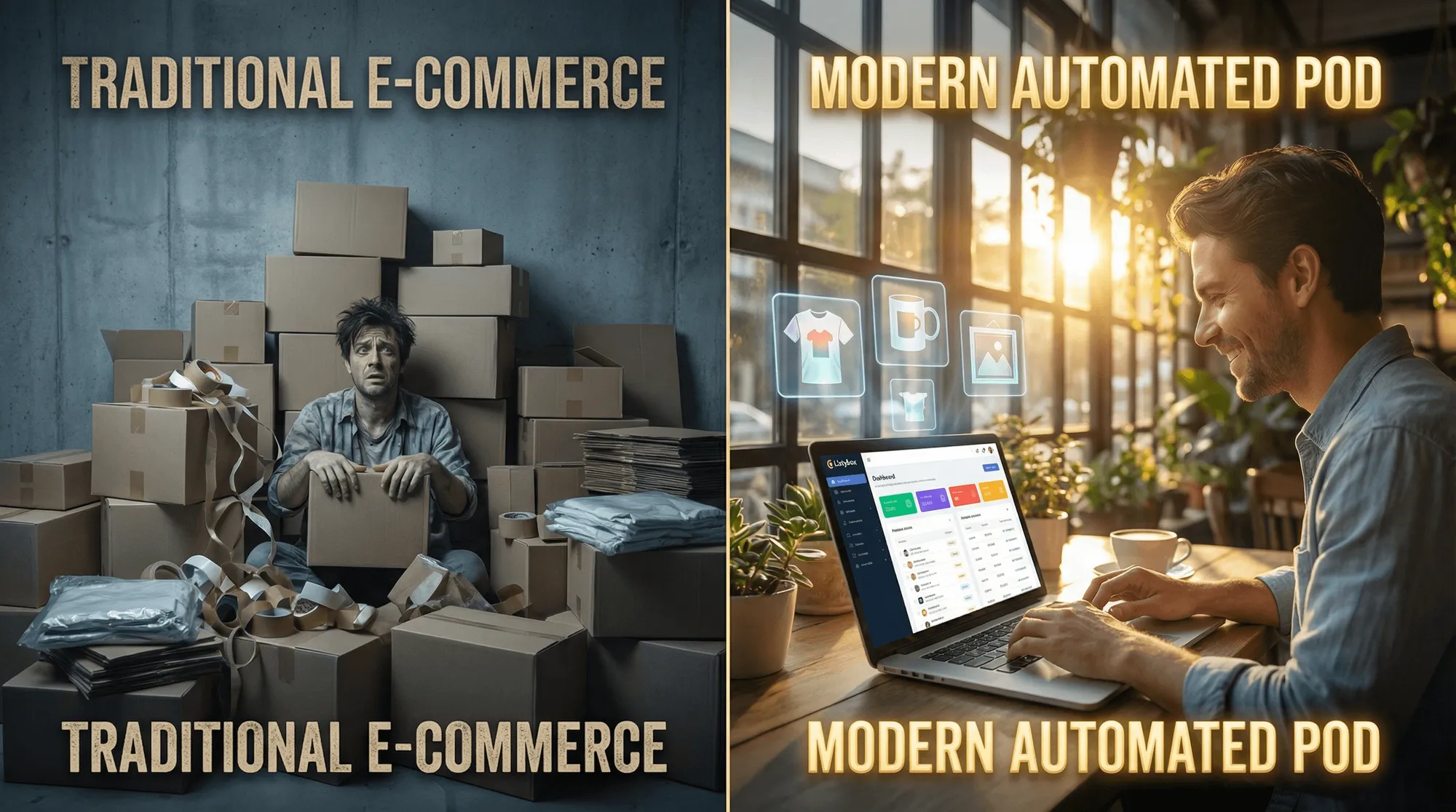
The e-commerce world is booming, and the question isn’t if you should start, but what you should sell. For many aspiring entrepreneurs, this decision paralysis is where the dream dies. Do you source electronics from overseas? Do you hand-knit scarves? Or do you try the digital download route?
The truth is, not all product categories are created equal. Some require thousands of dollars in upfront inventory, locking your cash in boxes that might never sell. Others require you to be a logistics expert, packing and shipping orders until 2 AM. But there is a smarter way. This guide navigates the chaotic sea of e-commerce options and points you toward the model that offers the highest profit potential with the lowest risk: Print-on-Demand (POD), supercharged by intelligent automation.
What Are the Main Business Models?
Before you pick a product, you must pick a vehicle. Your business model dictates your lifestyle, your risk, and your ceiling for growth. Let’s break down the reality of the three most popular paths.
1. Traditional Retail (Holding Inventory)
The Reality: You buy 500 units of a product upfront. You rent storage space. You manage shipping.
The Risk: If trends change or marketing fails, you are left with debt and a garage full of unsold goods. It is high risk and operationally heavy.
2. Standard Dropshipping
The Reality: You list cheap, generic products from overseas marketplaces. When a sale happens, a third party ships it.
The Risk: Branding is non-existent. Shipping times can take weeks, leading to angry customers. You have zero control over product quality.
3. Print-on-Demand (The Sweet Spot)
The Reality: You list custom products (t-shirts, mugs, decor). A product is only printed and shipped after a customer buys it.
The Risk: Near zero. You hold no inventory. You pay for the product only when you have already been paid. Plus, you build a unique brand asset, not just a commodity store.
This is where the magic happens. By leveraging Listybox’s Zero-Touch Order Management, you can operate a POD business that feels like a tech startup. Orders are detected, routed to the best manufacturer, and shipped with tracking completely automatically. You don’t touch a box; you just watch the dashboard.
Why Print-on-Demand is the Smartest Choice
Many beginners hesitate because they think POD is “saturated.” This is a myth. Bad designs and lazy sellers are saturated. High-quality, niche-focused brands are in higher demand than ever.
The Financial Advantage In traditional models, your profit margin is eaten by storage fees and dead stock. In POD, your cash flow is positive from day one. However, the manual work of creating listings for hundreds of products can be grueling.
Internal data reveals that the average successful POD seller needs about 200 active listings to generate consistent daily sales. Manually creating these would take approximately 80 hours of work. This “time tax” is why most quit.
This is where automation changes the game. With the Creation Wizard, you can upload your art once and apply it to hundreds of products in minutes, not weeks. It turns the biggest barrier to entry - time - into your competitive advantage.
Establishing a Brand, Not Just a Store To sell effectively, your products need to look professional. Standard dropshippers use grainy, generic images provided by suppliers. POD allows you to create a unique brand identity.
By using the ListyStyle mockup creator, you can instantly generate hundreds of photorealistic lifestyle images. Instead of a flat t-shirt on a white background, your customer sees a model wearing your design in a coffee shop or a cozy living room. This increases conversion rates significantly because you are selling a feeling, not just a product.
Product Categories That actually Sell
So, you have chosen the POD model. Now, what specifically should you put in your store? Here are the high-potential categories that drive revenue in 2024.
1. Apparel (The Evergreen King) T-shirts, hoodies, and sweatshirts remain the backbone of e-commerce. They are the perfect canvas for self-expression.
Strategy: Don’t just sell “a shirt.” Sell a shirt for “introverted dog moms” or “retro gaming enthusiasts.”
Pro Tip: Use Combo Listings to bundle a t-shirt, hoodie, and sweatshirt of the same design into one Etsy listing. Our analysis shows this can accelerate your journey to a “Bestseller” badge by up to 12x.
2. Home Decor With more people working from home, the demand for personalized space is huge.
Products: Canvas prints, metal posters, throw pillows, and blankets.
Advantage: These items often carry higher profit margins than apparel. You can secure these margins using our Lowest Price Guarantee, ensuring you get production costs that rival premium enterprise tiers.
3. Review: The “Trend Chaser” Persona Let’s look at a realistic scenario to see how this applies.
Meet Elena: A graphic designer who wanted to leave her 9-to-5.
Her Goal: Sell her digital art on physical products without handling shipping.
The Manual Grind: She started by manually uploading her designs to a basic POD site. She spent weeks researching keywords and writing descriptions. After a month, she had only 10 products live and zero energy left for marketing. She was burnt out before she made a dime.
The Hidden Trap: She missed a major holiday trend because she couldn’t move fast enough. By the time she designed and listed a Valentine’s Day mug, it was already February 15th.
The Listybox Solution: Elena switched to Listybox. She used the Trend Compass trend finder to identify a rising aesthetic in the “cottagecore” niche. Then, she used Magic Wand SEO tool to instantly write SEO-optimized titles and tags for 50 new products.
The Transformation: Instead of spending her nights data-entering, Elena now spends her time designing. Her store grew from 10 to 500 listings in two weeks, and she caught the holiday rush perfectly.
How to Start Without Getting Overwhelmed
The biggest enemy of a new e-commerce entrepreneur is complexity. You might be thinking, “I don’t know how to set up an Etsy store properly,” or “I’m scared of getting the SEO wrong.”
Does all of this feel overwhelming? You don’t have to start from scratch. With Listybox Store Setup, our expert team sets up your Etsy store, lists your first 10 products, and optimizes everything for SEO. This service is included FREE with annual Starter and Professional plans!
Once you are set up, consistency is key. You don’t need to work 24/7. You can batch your work on the weekend and use the Scheduled Publish feature to drip-feed your products to Etsy daily. This keeps the algorithm happy and your shop active, even while you sleep.
E-commerce is not about working harder anymore; it’s about working smarter with the right infrastructure. The products are out there, the demand is real, and the tools to automate your success are ready. The only missing piece is you.
Put this into practice in your shop.
Every step from design to live listing, on one platform. Start on the free plan.
No credit card required.